Accelerating Client Onboarding Through Automation and Self-Service
In high-value sales environments, delays in onboarding do not just slow down operations — they affect revenue, capacity and the speed at which new clients can begin delivering value.
Clients often spent far longer than expected in onboarding, creating friction in the sales pipeline
Our client had a complex onboarding process that required new customers to provide multiple forms of supporting documentation before they could be fully approved. This included certification, proof of qualifications, proof of address and photo ID.
These checks were a necessary part of the process, but collecting the information had become increasingly difficult. Clients often spent far longer than expected in onboarding, creating friction in the sales pipeline and increasing the amount of time internal teams had to spend chasing missing documents, answering questions and manually moving customers from one step to the next.
What should have been a controlled and efficient part of the customer journey had instead become a bottleneck.
The commercial effect of that delay was significant. The client had identified that reducing time spent in onboarding could save the business hundreds of thousands of pounds over the course of a year. The reason was simple: the sooner a client completed onboarding, the sooner they could begin earning. In some cases, individual clients were worth as much as £500,000 per year to the business, meaning every unnecessary delay carried a very real financial cost.
The client needed a faster, more structured onboarding journey that reduced manual involvement, improved visibility and made it easier for users to complete the process independently.
What had previously been a slow and fragmented process became a more structured, trackable and commercially effective onboarding system — improving both the customer experience and the operational performance behind it.
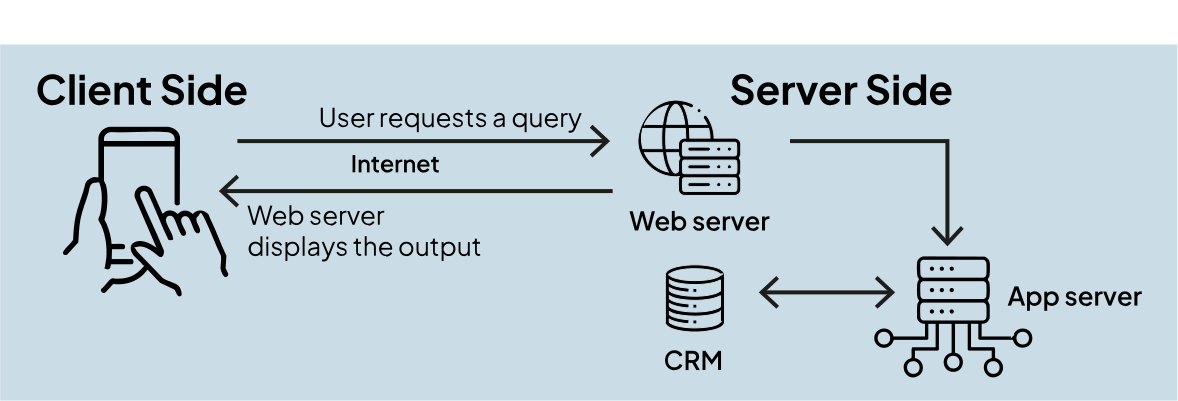
Working from those operational and commercial needs, we helped design and build a dedicated onboarding platform that integrated directly with the client’s CRM, in this case HubSpot, creating a scalable process through automation
A key part of the thinking was to treat onboarding not as a series of disconnected website pages, emails and manual follow-ups, but as a proper web application: a secure, login-based environment where users could complete actions, upload evidence and move through a structured workflow connected directly to the CRM. That mattered because the process needed to do more than inform users. It needed to let them act, progress and update their status inside a controlled system.
As soon as a deal reached the onboarding stage in the HubSpot pipeline, the system automatically created the user’s onboarding account and sent them an email inviting them to log in. This removed the need for team members to manually set up accounts or initiate the process, taking a large part of the administration out of the workflow from the outset.
Once inside the platform, users could move through the onboarding journey independently. The portal included training videos that had to be completed before a training session could be booked, ensuring the process was followed in the right order. The booking stage was then connected to a Microsoft calendar environment, where the calendars of individual team members were synchronised to create a more joined-up scheduling process.
Alongside the training journey, the platform also allowed users to upload all key onboarding evidence themselves, including certification, qualification documents, proof of address and photo ID. This meant customers could self-serve a large part of the onboarding process without needing direct support from staff.
The first point at which a team member needed to step in was when submitted evidence had to be reviewed and validated. Once documents were uploaded, a notification and HubSpot task were sent to the relevant deal owner, whose role was to check the evidence and decide whether it should be accepted and filed.
To make progress clearer for both the user and the business, the onboarding portal included a traffic light status system. Each document remained marked as orange while it was pending review, then changed to green once it had been validated by the team. This gave users immediate visibility over what had been approved and what was still outstanding, while also creating a clearer internal process for tracking onboarding completion.
Result
The new platform helped the client turn onboarding from a slow, manually driven process into a much more efficient self-service journey.
By automating account creation, login prompts, training progression, evidence submission and staff notifications, the business removed a significant amount of manual administration from the onboarding stage. Clients were able to move through the process more quickly and with greater clarity, while internal teams only needed to step in at the point where human review and validation genuinely added value.
This reduced friction in the pipeline, shortened the time clients spent in onboarding and helped the business move high-value customers into revenue-generating activity much faster.
For a business where some individual clients were worth up to £500,000 annually, even small reductions in onboarding time carried major commercial value. At scale, those efficiency gains represented the potential to save the company hundreds of thousands of pounds each year.
What had previously been a slow and fragmented process became a more structured, trackable and commercially effective onboarding system — improving both the customer experience and the operational performance behind it.