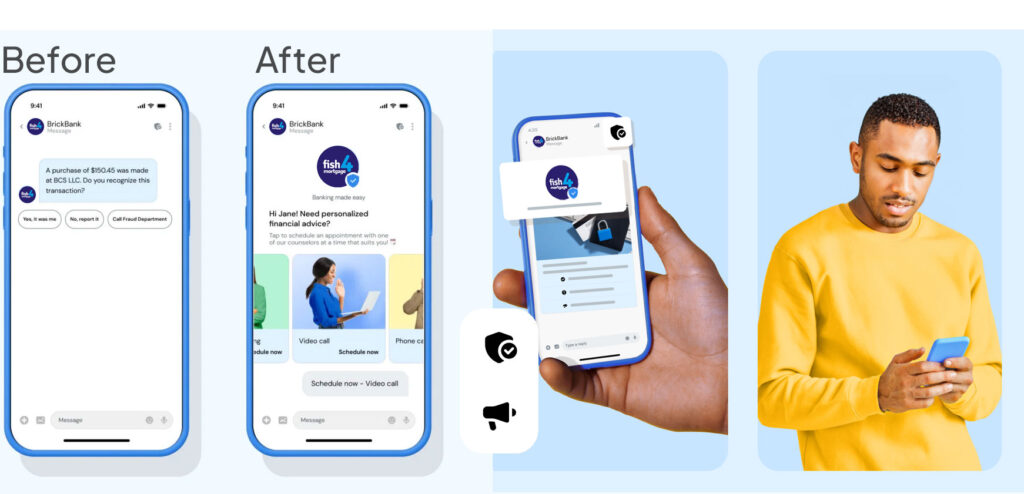
Branded Customer Engagement Channel with RCS Messaging
STEVEN G JAMES, DIRECTOR, FEDERATION DESIGN
Moving from Standard SMS to RCS for Branded, Interactive Customer Messaging to Improve Trust and Response Rates
When mobile messaging is handled well, it does more than deliver information — it creates trust, drives action, and opens conversations. For this client, the opportunity was clear: move beyond basic SMS and adopt a richer, more credible messaging channel built for modern customer engagement.
Our client had already identified a clear weakness in their outbound messaging performance.
Messages sent from a standard mobile number were generating lower response rates than messages sent using an alphanumeric sender ID displaying the company name. The reason was straightforward: branded sender identity builds confidence. A named sender feels more legitimate, more recognisable, and more trustworthy than an unfamiliar number appearing out of context.
At the first point of contact, that difference matters.
The client had also seen that two-way messaging consistently outperformed one-way communication. Customers were more likely to engage when the interaction felt open and conversational rather than simply being pushed a static outbound message.
So the challenge was no longer just about sending messages. It was about improving the quality of the channel itself.
The business needed a messaging approach that could combine:
branded sender credibility
stronger customer trust at first contact
richer messaging capability
more effective two-way engagement
a more scalable platform for future automation
With wider market adoption growing, RCS messaging was the obvious next step.
We helped the client move towards RCS Business Messaging as a more advanced customer communications layer.
This was the right move because RCS closes the gap between traditional SMS and the kind of rich, guided messaging experience customers now expect from brands. Instead of relying on plain-text communication from a generic number, RCS allows businesses to present themselves in a far more credible and controlled way through branded business messaging, richer content, and more structured interaction.
From a customer experience perspective, this immediately improves the quality of the first touchpoint.
From a systems perspective, it opens up a much more powerful messaging model.
RCS supports rich messaging capability, which means the message itself can do more than just deliver text. It can carry branding, media, action prompts, and guided reply options, helping the business shape the interaction rather than simply waiting for an open-ended response. That makes the channel more useful for customer engagement flows where speed, clarity, and action matter.
Just as importantly, RCS platforms can sit inside a much broader automation ecosystem.
Because modern messaging platforms can integrate with CRMs and workflow tools, RCS can be triggered by operational events rather than handled manually. A CRM stage change, lead status update, onboarding milestone, booking confirmation, or service event can all be used to trigger a branded outbound message automatically. Customer interactions can then feed back into the CRM, allowing engagement data to support routing, follow-up, and next-step automation.
That turns messaging from a standalone outbound task into a connected part of the commercial workflow.
In practical terms, the architecture can support a flow like this:
A lead or customer reaches a defined stage in the CRM
An automation triggers an RCS message
The customer receives a branded, richer message experience
Their response or interaction is captured
The CRM is updated and the next workflow step is triggered automatically
This gave the client a clear route towards a mobile messaging strategy that was not only more credible at the point of contact, but also better suited to modern engagement, automation, and scale.
Result
The move towards RCS positioned the client to upgrade mobile messaging from a basic communication channel into a more strategic customer engagement tool.
It addressed the trust issue that had already been identified in standard number-based messaging by introducing a more branded and credible experience at first contact. It also built on the client’s own performance insight that two-way engagement delivers stronger results than one-way outbound traffic.
The result was a messaging strategy with far more commercial value.
Instead of choosing between branded trust and conversational engagement, the client now had a route to both. Messaging could become more recognisable, more interactive, and more aligned with the wider customer journey.
At the same time, the integration potential with CRM and automation platforms created a much stronger operational foundation. Messaging no longer had to sit outside the system. It could become part of it — triggered automatically, tracked properly, and connected directly to customer progression.
What started as a response-rate issue became an opportunity to modernise the channel entirely.
The outcome was a more credible, more intelligent, and more scalable approach to customer messaging — one that better reflects how brands need to communicate in a mobile-first environment.