How Clearer Attribution Helped the Client Make Better Marketing Investment Decisions, Improving marketing ROI
With a more structured attribution model in HubSpot, the client gained clearer visibility over which channels were generating leads, which were generating customers, and where marketing budget was creating the most commercial value.
When marketing investment is spread across multiple channels, platforms and campaigns, lead volume alone is not enough to guide decision-making.
For businesses investing seriously in acquisition, the real challenge is understanding which sources are driving qualified leads, which are contributing to sales, and what each result is actually costing. Without that level of visibility, it becomes difficult to optimise spend with confidence as the marketing ROI is unclear from campaign to campaign.
That was the position the client found themselves in. They were already investing heavily across multiple advertising channels and had HubSpot in place as their CRM, but the reporting structure was not yet giving them the clarity they needed. Lead generation was visible, but attribution was not mature enough to provide a clear view of where leads were originating, how those leads were moving through the pipeline, or which acquisition sources were ultimately contributing to converted business. The activity was there, but the line of sight between marketing spend and commercial outcome was still too limited.
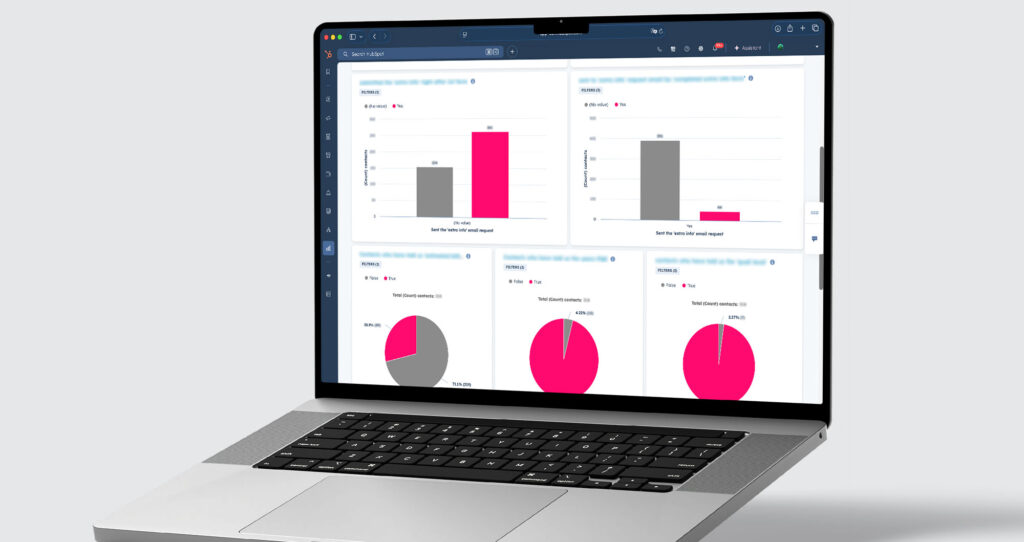
By linking acquisition data to CRM outcomes, granular dashboards made marketing performance measurable in commercial terms — because what gets measured gets improved.
This created a common but important problem: high marketing activity, but limited confidence in what was truly performing. Some sources appeared productive in terms of lead volume, but it was unclear whether those leads were converting well. Others may have been producing fewer enquiries, but stronger downstream value. Without being able to segment results properly by source, channel and campaign, the client could not compare performance in a meaningful commercial way or make budget decisions with as much certainty as they needed.
Working closely with the client, we helped build a more granular attribution model inside HubSpot that gave them a clearer framework for analysing performance. The objective was not simply to produce more reports, but to make the CRM more useful as a decision-making tool. By structuring inbound data so it could be segmented by source, channel and campaign, the client gained a more detailed view of how acquisition activity was contributing at different stages of the funnel.
We then developed a reporting suite that allowed performance to be understood from multiple angles. This gave the client clearer visibility over which sources were generating the highest lead volumes, which were producing the highest number of clients, where cost and outcome were most closely aligned, and where acquisition quality differed from acquisition quantity. That distinction was especially important, because it allowed the client to separate visibility from value. Instead of treating all enquiries as equal, they could start to assess marketing activity in more commercial terms.
By connecting acquisition data to downstream CRM outcomes, the client was able to evaluate performance more clearly against metrics such as cost per acquisition (CPA) and cost per conversion (CPC).
This gave them a much stronger basis for comparing the relative efficiency of different channels and campaigns, and for identifying where spend was creating genuine commercial return rather than simply generating volume.
The outcome was a more confident, more informed approach to budget allocation. With source-level attribution and segmented reporting in place, the client could identify which channels were not only productive, but genuinely valuable in terms of lead quality and converted business. Some activities were reduced or stopped altogether, while additional budget could be directed towards the sources that had been shown to perform more efficiently.
Rather than relying on assumption, anecdotal feedback or top-line lead counts, the client gained a clearer view of what was actually driving results. The reporting model did not just improve visibility; it gave them a more reliable basis for making investment decisions, improving marketing ROI and continuing to optimise performance over time.